Key Takeaway
A complete 50-point technical SEO checklist for 2026. Audit crawlability, Core Web Vitals, mobile usability, schemas, and AI search readiness for top rankings.
Executive Overview: Mastering technical SEO checklist 2026
A complete 50-point technical SEO checklist for 2026. Audit crawlability, Core Web Vitals, mobile usability, schemas, and AI search readiness for top rankings.
✅ Key Takeaways — technical SEO checklist 2026
- Technical errors cause sudden ranking drops that take weeks to resolve; audit your infrastructure first before scaling content
- Core Web Vitals (INP < 200ms, LCP < 2.5s, CLS < 0.1) are confirmed ranking factors that directly affect user retention
- Mobile-first indexing means Google uses your mobile page as the primary version; keep content consistent across devices
- Structured data with Article, Author, and FAQPage schemas provides the machine-readable clarity AI search models look for
- A complete technical audit evaluates 50 critical checkpoints across crawling, speed, schemas, mobile usability, and security
💡 Strategic Key Insight: technical SEO checklist 2026
Technical SEO is the foundation that allows every other marketing effort to deliver returns. A single robots.txt misstep, missing canonical, or unhandled server latency can wipe out months of link building and content work. This 50-point checklist keeps your site clean, fast, and ready for 2026 search indexation.
1. Why Technical SEO Is the Non-Negotiable Foundation of All Search Rankings in 2026
Technical SEO forms the infrastructure layer of organic search performance. It is the practical set of configurations, optimizations, and architectural choices that decide whether search engine crawlers can discover, render, index, and rank your pages properly. In 2026, technical SEO reaches well beyond routine crawlability. It now takes in AI search readiness, structured data for generative engines, Core Web Vitals as confirmed ranking factors, and mobile-first indexing as the baseline standard across the web.
The consequences of technical errors are severe. A single misconfigured robots.txt directive can knock hundreds of high-value pages out of Google's index. A missing canonical tag splits authority between duplicate URLs, while slow server response times can slash your crawl budget by as much as 70%. Unlike slow content decay, technical errors trigger abrupt ranking drops that often take weeks to recover from.
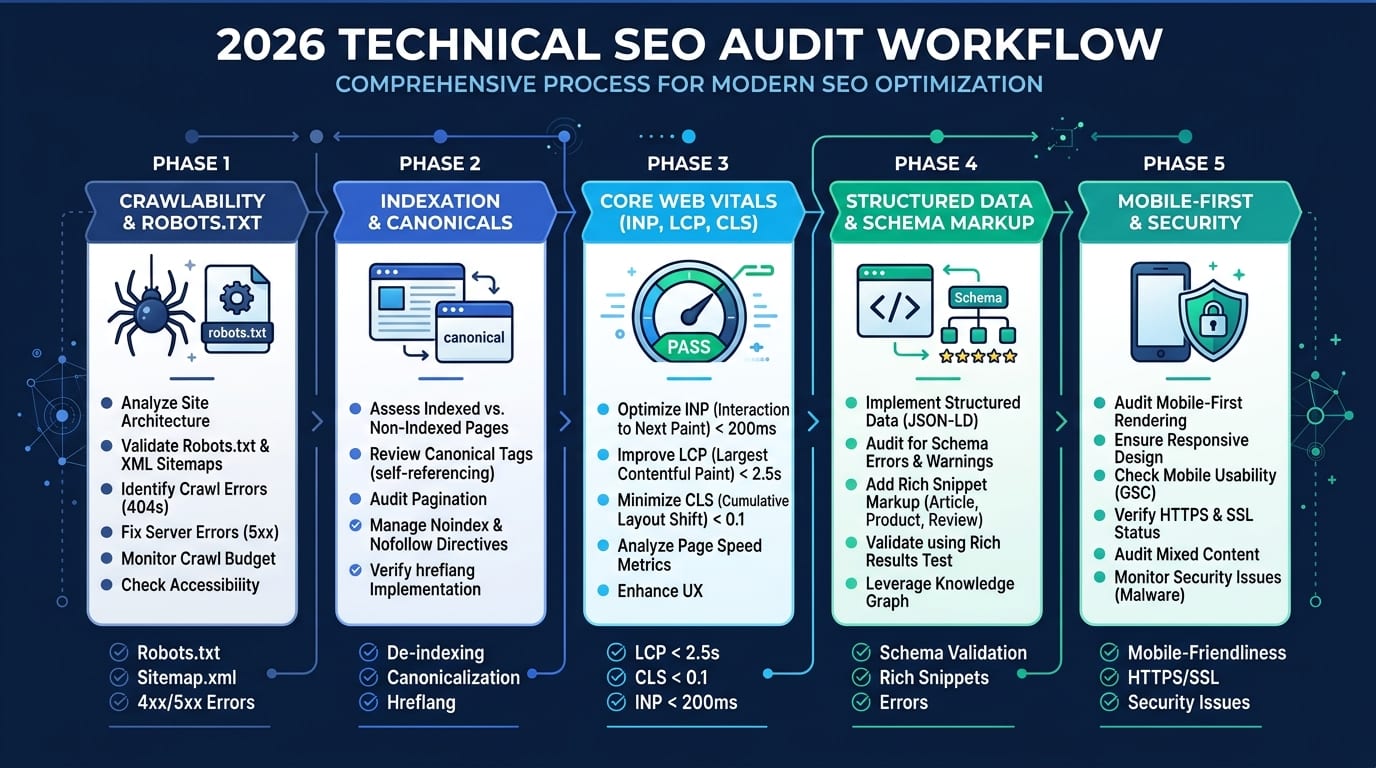
Figure 1: 2026 Technical SEO Audit Workflow covering crawlability, indexation, Core Web Vitals, schema markup, and mobile security.
Run an immediate audit on your site using our Free Deep SEO Audit Tool, which checks all 50 technical checkpoints in under a minute. If you need dedicated hands-on remediation, our Technical SEO Service in Bangladesh provides complete diagnosis and implementation.
2. Crawlability and Indexation Checklist: 10 Points That Determine If Google Can Find You
The 10 foundational crawlability and indexation checkpoints are: (1) Robots.txt: confirm no important pages, CSS, or scripts are blocked; (2) XML Sitemap: submitted to Search Console and updated within 24 hours of new content; (3) Crawl Budget: verify Googlebot spends crawl allowance on priority pages, not pagination or parameterized URLs; (4) Redirect Chains: ensure every 301 resolves in a single hop with zero chains; (5) Canonical Tags: verify every page has a self-referencing canonical, and duplicate variants point to the main source.
Continuing the checklist: (6) Index Coverage: check Google Search Console for zero unhandled 'Excluded by noindex' notices on target pages; (7) Internal Linking Depth: keep all high-value pages reachable within 3 clicks from the homepage; (8) URL Structure: keep URLs clean, lowercase, and hyphen-separated without underscores; (9) Pagination: implement rel=next/prev annotations or canonical consolidation; (10) Hreflang: implement reciprocal tags if you serve multiple regions or languages.
Check your robots.txt file and create an XML sitemap using our Robots.txt & Sitemap Builder.
3. Core Web Vitals Checklist: INP, LCP and CLS Thresholds Every Page Must Meet
Core Web Vitals are confirmed Google ranking signals with concrete thresholds. The three metrics every site must meet in 2026 are: Interaction to Next Paint (INP) below 200ms; Largest Contentful Paint (LCP) below 2.5 seconds; Cumulative Layout Shift (CLS) under 0.1. Pages that miss these numbers give up rank to faster competitors. In our audits, main-thread blocking JavaScript is the most common cause of poor INP. Unoptimized hero banners hurt LCP most often, while missing width and height attributes on images trigger unexpected layout shifts.
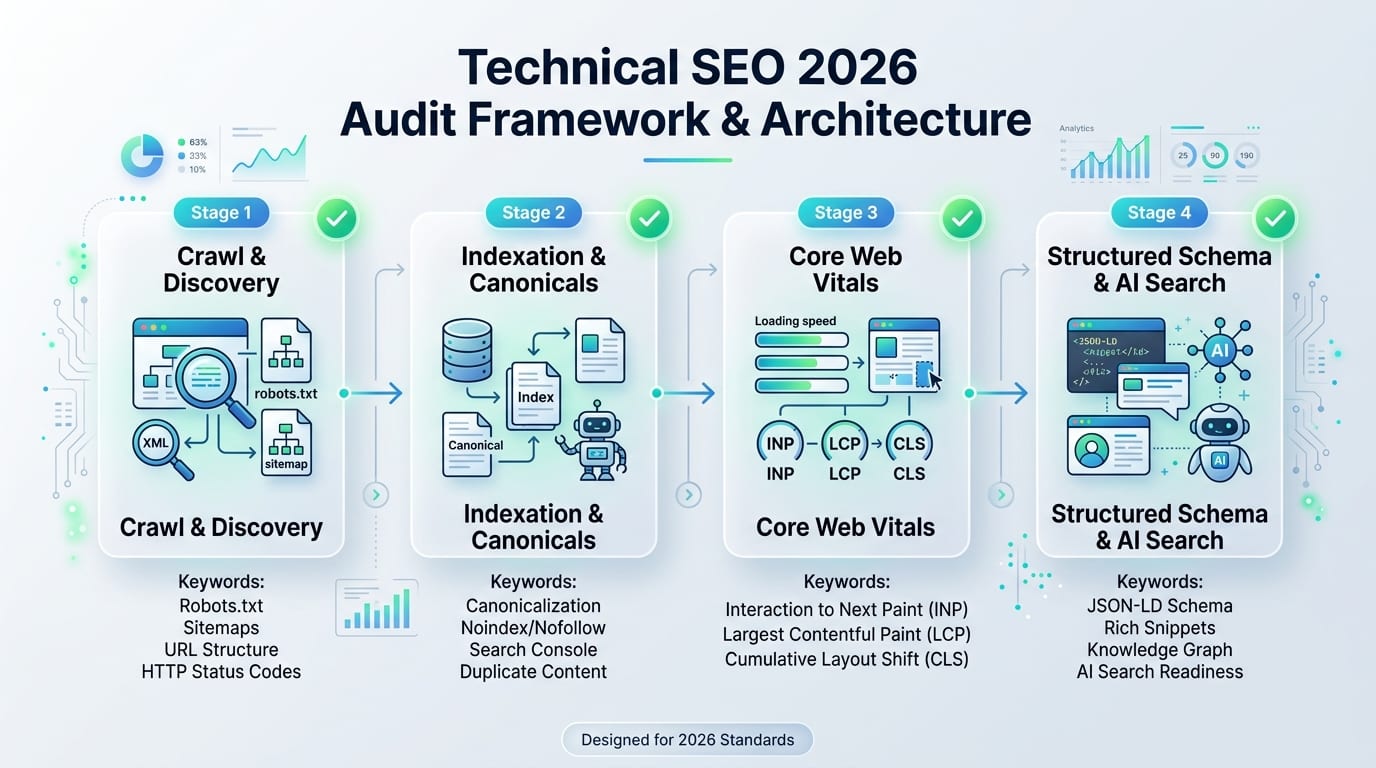
Figure 2: Complete technical SEO audit architecture map across crawlability, rendering, and performance thresholds.
To diagnose performance issues accurately, look at both lab data in PageSpeed Insights and real-user field data in Google Search Console's Core Web Vitals report. Many sites score well on a developer desktop but struggle under field conditions where mobile processors and varying network speeds test real user responsiveness.
Our Technical SEO Service includes full Core Web Vitals remediation sprints. You can inspect verified real-world metrics in our 1.18M Clicks Case Study.
4. Structured Data and Schema Markup Checklist for Rich Results and AI Overviews
Structured data acts as the technical bridge between your page content and search engines, powering both traditional rich results and generative AI citations. The structured data checklist includes: (1) Article schema with author, datePublished, and dateModified on blog posts; (2) FAQPage schema on pages with question-based sections; (3) HowTo schema on step-by-step guides; (4) Product and AggregateRating schema on ecommerce catalog items; (5) LocalBusiness schema on service pages with verified NAP details; (6) BreadcrumbList schema for navigation breadcrumbs; (7) SiteLinksSearchBox schema on the homepage. Always validate schemas with Google's Rich Results Test.
To optimize for modern AI search engines, add: (8) Organization schema with sameAs links on the homepage; (9) Person schema with verified credentials on About and author pages; (10) SpeakableSpecification schema on content targeting voice assistants. These schemas give search bots unambiguous machine-readable context about your business entity.
Generate and validate these schemas with our Schema Markup Generator, then verify live formatting using Google's Rich Results tool before deploying.
5. Mobile-First Indexing and Page Experience Checklist: What Google Measures in 2026
Google evaluates the mobile version of your page as the primary canonical version under mobile-first indexing, even when most of your visitors use desktop screens. The mobile checklist requires: (1) Responsive layouts without horizontal scrolling on 375px viewports; (2) Touch targets with at least 48x48 pixel tap areas; (3) Font sizes of 16px or larger for readable body copy; (4) No outdated or unsupported mobile scripts; (5) Identical content between mobile and desktop layouts so mobile visitors see the exact same information.
Broader page experience signals also count. Your site must serve all pages over HTTPS with an active SSL certificate. Intrusive full-screen popups on mobile trigger direct ranking penalties. Review your security standing in Google Search Console to verify zero malware flags. Check your HTTPS redirects and security headers using our HTTP & SSL Header Checker.
Audit mobile usability warnings directly in Google Search Console under Mobile Usability, and resolve any viewport or tap target errors before rolling out major content campaigns.
6. Security, International and Advanced Technical SEO Checklist
Advanced technical SEO includes several areas that teams easily overlook: (1) Log File Analysis: inspect server logs to verify Googlebot spends its time on priority pages; (2) JavaScript Rendering: ensure all vital text and links render in the initial server HTML, not only via client-side hydration; (3) International SEO: configure hreflang tags with reciprocal links when serving multiple countries; (4) Faceted Navigation: apply canonical tags or robots rules to stop parameter bloat from product filters; (5) Security Headers: deploy Content-Security-Policy, X-Frame-Options, and HSTS headers for added trust and security.
Security issues directly impact search visibility. Sites flagged for malware or deceptive downloads in Google's Safe Browsing database get warning interstitials in Chrome and rapid ranking drops. Review Google Search Console's Security Issues report monthly, and keep third-party scripts closely audited.
For complete technical audits and remediation, work with our Technical SEO Service team, or start with our free Deep SEO Audit Tool.
Comparative Analysis: Common Failure Point vs. Correct Implementation
| Technical SEO Area |
Common Failure Point |
Correct Implementation |
| Robots.txt |
Accidentally blocking CSS, JS, or key directories |
Allow all resources; disallow only thin parameter URLs |
| Core Web Vitals: LCP |
Unoptimized hero image formats (PNG/JPEG) |
Use WebP or AVIF hero images with preload links |
| Core Web Vitals: INP |
Undeferred third-party JavaScript bundles |
Defer non-critical scripts and break long CPU tasks |
| Schema Markup |
Missing FAQPage schema on Q&A content |
Stack FAQPage, Article, and Person schemas cleanly |
| Mobile-First |
Hidden text inside mobile accordions |
Keep visible content identical across screen sizes |
| Security |
HTTP mixed content or missing SSL certificates |
Enforce full HTTPS with HSTS and resolve mixed assets |
Actionable Implementation Roadmap for technical SEO checklist 2026
-
Rapid Site Audit:
Run our Free Deep SEO Audit Tool to get an immediate technical health score with prioritized issue list.
-
Crawlability Fix:
Review robots.txt using our Robots & Sitemap Builder. Submit updated XML sitemap to Google Search Console.
-
Core Web Vitals Sprint:
Run PageSpeed Insights on your top 10 pages. Fix LCP image optimization, defer non-critical JavaScript, and reserve layout space for dynamically loaded elements.
-
Schema Deployment:
Add Article + FAQPage + Author schema to all blog posts using our Schema Markup Generator. Validate with Google Rich Results Test.
-
SSL & Security Verification:
Check all pages for HTTPS and mixed content issues using our HTTP & SSL Header Checker.
Frequently Asked Questions — technical SEO checklist 2026
Q1: What is a technical SEO audit?
A technical SEO audit is a systematic check of your website infrastructure, covering crawlability, indexation, Core Web Vitals, structured data, mobile experience, and security to make sure search engines and AI models can find and rank your pages without issues.
Q2: How often should I run a technical SEO audit?
Run a full audit every quarter, and do quick crawl checks after major updates like CMS migrations, template updates, or URL changes. Monitor Google Search Console weekly for unexpected coverage drops.
Q3: What are the most critical technical SEO issues to fix first?
Start with index coverage errors where pages are accidentally excluded, then fix Core Web Vitals failures (LCP over 2.5s, INP over 200ms), resolve missing HTTPS certificates, and repair broken internal redirect chains.
Q4: Does technical SEO affect AI Overview eligibility?
Yes. AI models favor pages that render quickly, provide explicit schema metadata, and present clean machine-readable answers. Crawl issues directly disqualify pages from citation eligibility.
Q5: What tools should I use for a technical SEO audit?
Use Google Search Console for coverage and Core Web Vitals, PageSpeed Insights for page performance, Screaming Frog for crawl analysis, and our Free Deep SEO Audit Tool for a rapid site health check.
Ready to Accelerate Rankings for technical SEO checklist 2026?
Partner with Abdullah Saleh — Lead SEO Strategist & AI Search Architect — to build an organic growth engine that delivers sustainable results.

Abdullah Saleh
Lead SEO Strategist & AI Search Architect
Abdullah Saleh is an Organic Business Growth Specialist and Technical SEO Expert helping global brands achieve authoritative rankings and citations across Google Search, Google AI Overviews, ChatGPT Search, and Perplexity AI.


 Technical SEO