Structured Data & JSON-LD Mastery: Every Schema Type Google Supports for Rich Results in 2026
Published: 2026-10-18 Updated: 2026-10-18 11 min read By Abdullah Saleh
Share this Guide / ToolHelp colleagues & business owners scale their organic rankings
Key Takeaway
Structured data and JSON-LD schema markup unlock rich results in Google Search and AI Overview citations. This complete guide covers every schema type supported by Google in 2026, with implementation code, validation steps, and prioritization by impact.
Executive Overview: Mastering structured data JSON-LD 2026
Structured data and JSON-LD schema markup unlock rich results in Google Search and AI Overview citations. This complete guide covers every schema type supported by Google in 2026, with implementation code, validation steps, and prioritization by impact.
✅ Key Takeaways — structured data JSON-LD 2026
JSON-LD is Google's recommended structured data format — use it for all schema implementations
FAQPage + Article + Person is the minimum schema stack for blog posts targeting AI Overview citations
All JSON-LD must pass Google's Rich Results Test with zero ERRORs before deployment
Organization schema with sameAs links is essential for brand entity recognition in Google's Knowledge Graph
💡 Strategic Key Insight: structured data JSON-LD 2026
JSON-LD structured data is Google's recommended implementation method for all schema markup. FAQPage, HowTo, Article, Product, and LocalBusiness schema are the five highest-impact schema types for both traditional rich results and AI Overview citation eligibility in 2026. All schema must be validated with Google's Rich Results Test before deployment.
1. What Is Structured Data and Why Is JSON-LD the Best Implementation Method?
Structured data is machine-readable code added to a webpage's HTML that explicitly communicates the content's meaning, context, and entities to search engines. Rather than requiring Google's algorithms to infer what a page is about from natural language text, structured data provides direct, unambiguous answers: 'This page is an Article, written by [Person name], published on [Date], about [Topic], with a rating of [Value].' This clarity dramatically improves how Google understands, categorizes, and displays your content in search results.
JSON-LD (JavaScript Object Notation for Linked Data) is Google's recommended implementation method for structured data. Unlike Microdata and RDFa (which require embedding attributes throughout the HTML), JSON-LD is placed as a self-contained <script> block in the page's <head> or <body>, making it easy to implement, maintain, and update without editing the visible page HTML. Google's Search Central documentation explicitly recommends JSON-LD as the preferred format for all structured data implementations.
Generate validated, production-ready JSON-LD for 15+ schema types using our Schema Markup Generator. For a complete structured data audit of your existing site, use our Free Deep SEO Audit Tool.
2. The 8 Highest-Impact Schema Types for Google Rich Results in 2026
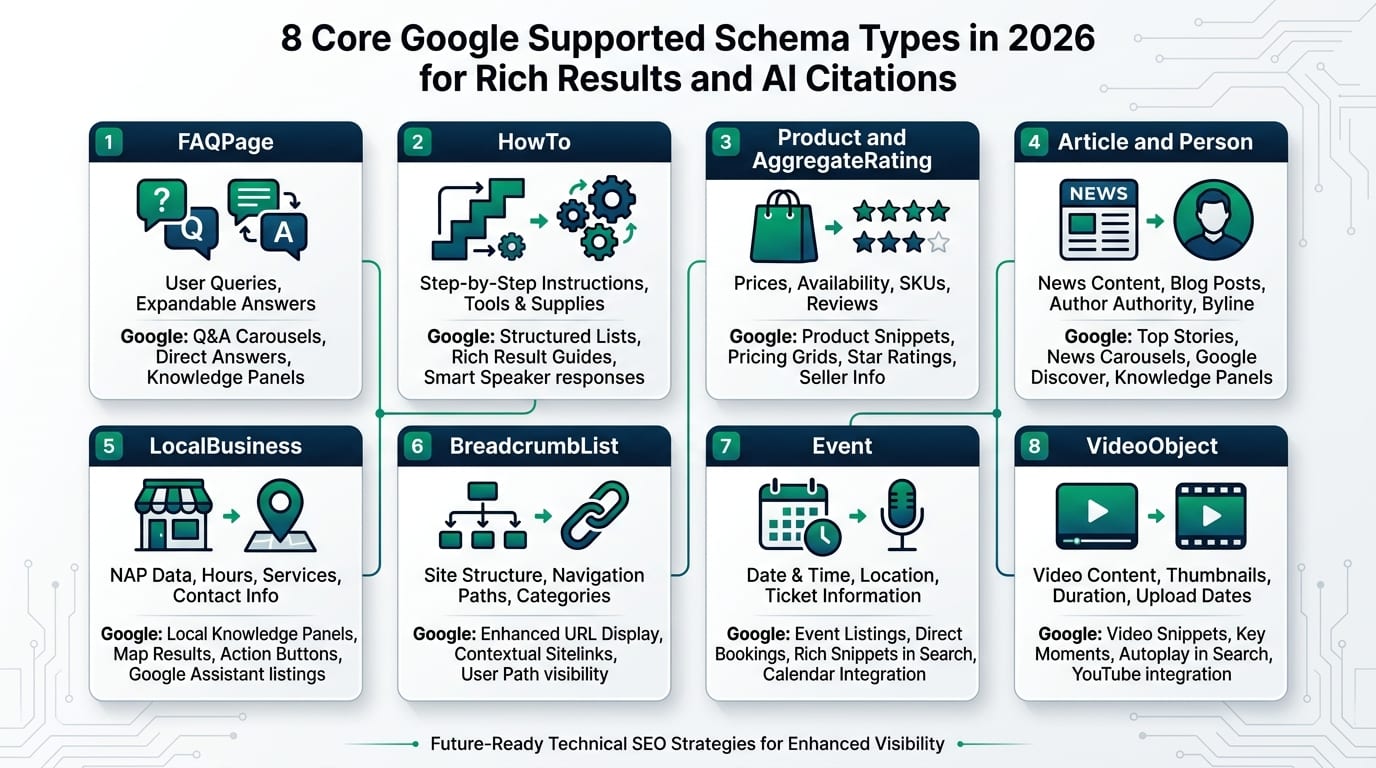
The eight highest-impact schema types for Google rich results in 2026, ranked by implementation ROI, are: (1) FAQPage — displays expandable Q&A pairs on the SERP; (2) HowTo — shows numbered steps with images in rich results; (3) Article — provides authorship and date signals for news and blog content; (4) Product + AggregateRating — shows star ratings, price, and availability for e-commerce; (5) LocalBusiness — powers local pack inclusion and Knowledge Panel data; (6) BreadcrumbList — displays site hierarchy in the SERP URL path; (7) Event — shows event dates, locations, and ticket availability; (8) VideoObject — enables video rich results in both Google Search and YouTube.
For AI Overview eligibility specifically, the three most important schema additions are Person schema (for author E-E-A-T signals), Organization schema with sameAs links (for brand entity recognition), and SpeakableSpecification (for voice search and audio AI responses). These three types operate below the threshold of visual rich results but significantly influence how Google's LLMs evaluate your content's authority and citation worthiness.
8 Core Google Supported Schema Types in 2026 — FAQPage, HowTo, Product, Article, LocalBusiness, BreadcrumbList, Event, VideoObject.
Our AEO Optimization Service includes a full structured data strategy covering both rich results and AI search readiness across all 8 priority schema types.
3. FAQPage & HowTo Schema: Step-by-Step Implementation for AI Overview Eligibility
FAQPage schema implementation begins with identifying 4–6 genuine questions that your target audience asks about the page's primary topic. These questions must be answered directly on the page in visible HTML — Google penalizes FAQPage schema that references answers not visible to users. The JSON-LD structure nests each question-answer pair within a @type:'Question' object inside the @type:'FAQPage' parent.
A complete FAQPage JSON-LD block for a technical SEO page would look like: {"@context":"https://schema.org","@type":"FAQPage","mainEntity":[{"@type":"Question","name":"What is technical SEO?","acceptedAnswer":{"@type":"Answer","text":"Technical SEO is the process of...[40-word answer]"}}]}. Best practice is to write each answer as a standalone 30–50 word definition that can be extracted by AI systems as a complete, self-contained response — this maximizes both FAQ rich result eligibility and AI Overview citation probability simultaneously.
HowTo schema follows a similar pattern but uses @type:'HowToStep' objects nested within @type:'HowTo', with each step containing a 'name' (the step title) and 'text' (the step description). Include 'estimatedCost' and 'totalTime' where applicable to unlock the full HowTo rich result display. Generate both FAQPage and HowTo schema instantly with our Schema Markup Generator.
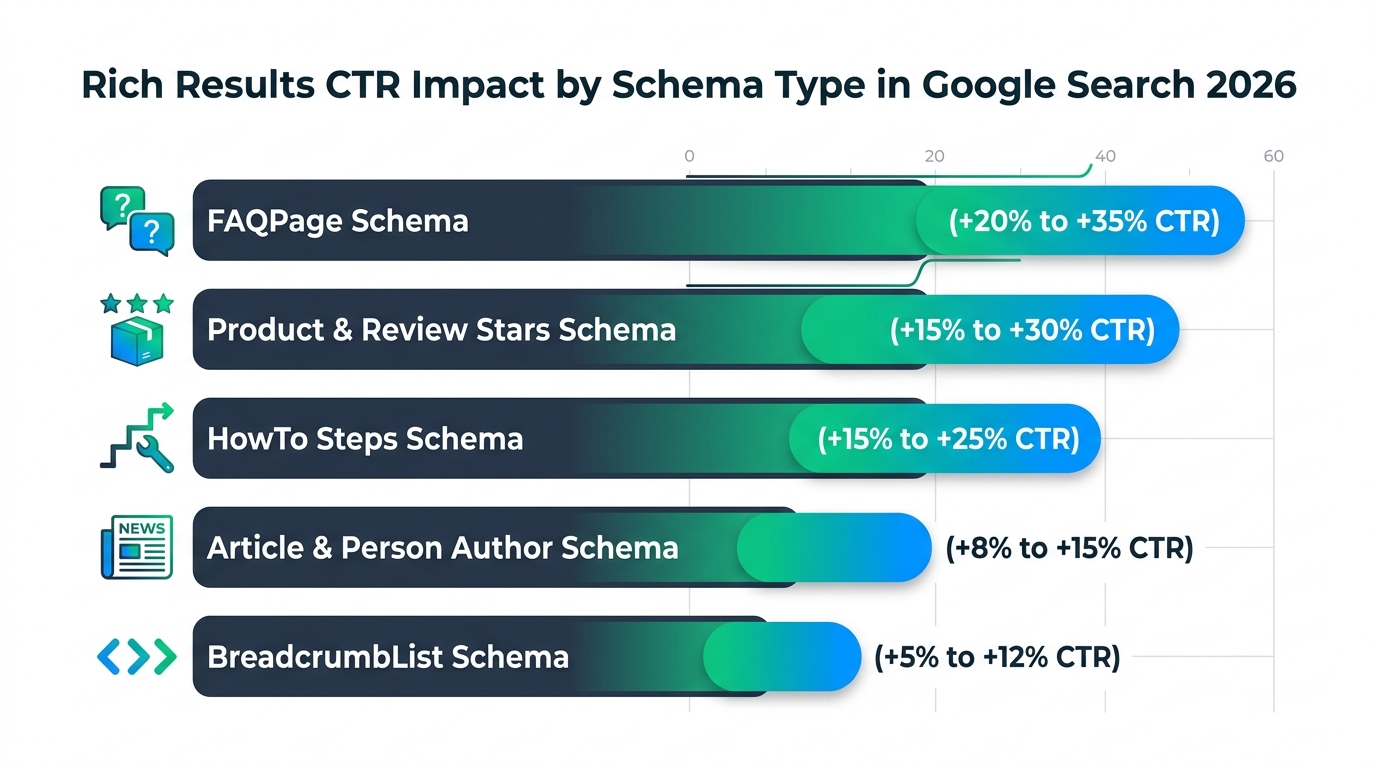
E-commerce structured data is among the highest-ROI schema implementations available — Product schema with AggregateRating consistently delivers 15–30% CTR improvements for product pages by displaying star ratings, price, and availability directly in Google Search results. The full Product schema stack for maximum e-commerce rich results includes: @type:'Product' (core product identity), 'offers': @type:'Offer' (current price and availability), 'aggregateRating': @type:'AggregateRating' (average review score and count), and 'review': @type:'Review' array (individual reviewer data).
Critical e-commerce schema rules to follow: never fabricate review ratings — Google manually audits a sample of Product schema and will penalize or exclude sites found misrepresenting ratings; always keep price and availability data current — stale pricing in Product schema triggers 'Misleading structured data' manual penalties; use the 'sku' and 'mpn' (manufacturer part number) properties to enable Google Shopping integration. Our Ecommerce SEO Service includes full product schema implementation and ongoing validation.
Average organic CTR uplift by schema type in Google Search — FAQPage and Product schema deliver the highest organic click gains.
For Shopify and WooCommerce stores, use platform-native structured data plugins that auto-generate Product schema from your product database — this ensures pricing and availability are always current without manual updates.
5. Local Business & Organization Schema for Local Pack & Knowledge Panel
LocalBusiness schema is the foundational structured data for any business with a physical location or defined service area. At minimum, LocalBusiness schema must include: 'name' (exact legal business name), 'address' (PostalAddress type with street, city, region, postal code, and country), 'telephone' (primary business phone in E.164 format), 'url' (homepage URL), and 'openingHoursSpecification' (days and hours of operation). For maximum local search impact, also include 'geo' (latitude/longitude coordinates), 'priceRange', 'servesCuisine' (for restaurants), and 'sameAs' linking to Google Business Profile, Facebook, and Yelp.
Organization schema extends LocalBusiness for brands and agencies. The critical Organization additions for GEO (Generative Engine Optimization) are the 'sameAs' array — linking to all verified brand profiles including LinkedIn, Crunchbase, Wikipedia, Wikidata, and industry associations — and the 'founder' property linking to a Person schema with the founder's credentials. This two-tier entity structure is what enables Google's Knowledge Graph to recognize your brand as a verified entity eligible for Knowledge Panel display.
Our Local SEO Service includes complete LocalBusiness and Organization schema implementation as part of the foundational local SEO setup.
6. Schema Validation, Testing & Common Implementation Errors to Avoid
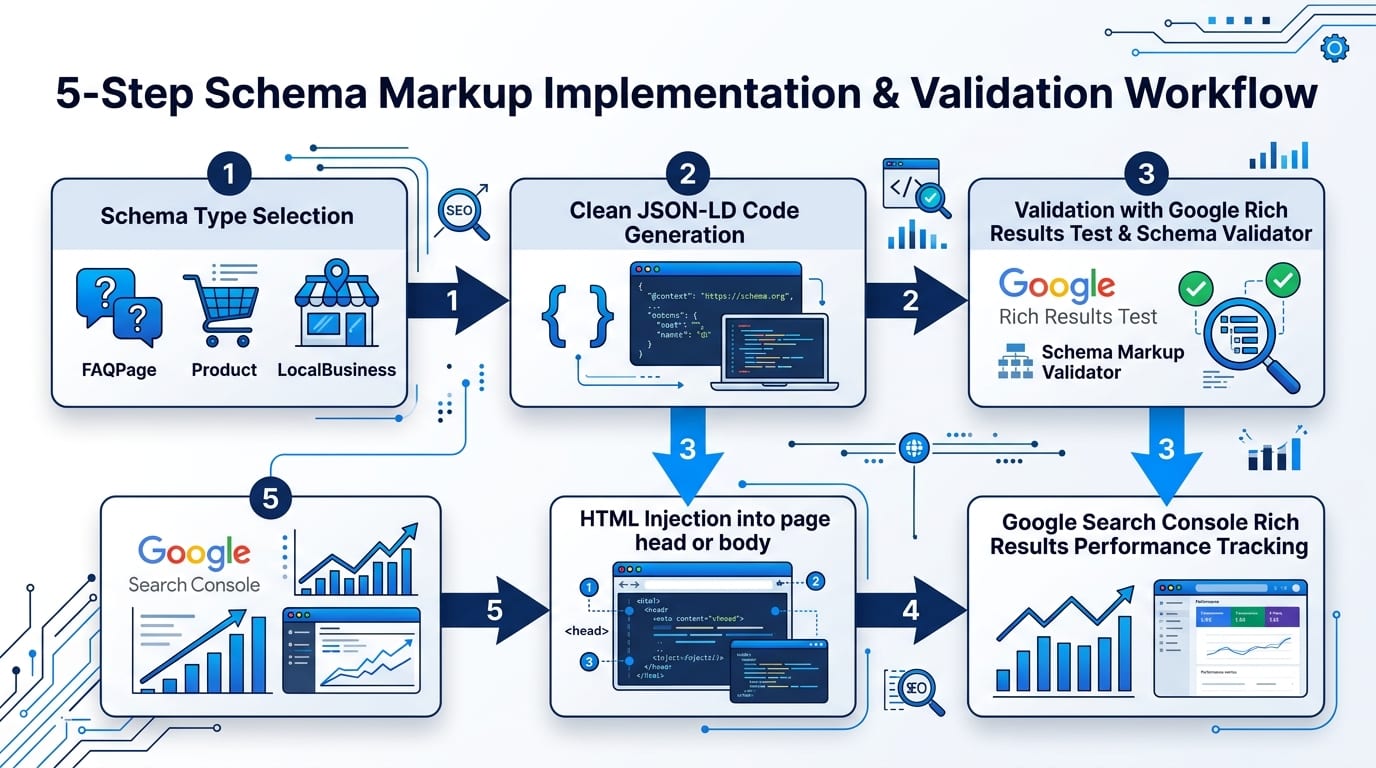
Schema validation is non-negotiable before deployment. Unvalidated schema with syntax errors is not only useless — it can actively confuse Google's parsers and trigger manual penalties for 'Misleading structured data.' The validation workflow is: (1) Generate your JSON-LD using a reliable tool; (2) Test it in Google's Rich Results Test (search.google.com/test/rich-results) — resolve every ERROR before proceeding; (3) Test a sample in the Schema Markup Validator (validator.schema.org) for schema.org compliance; (4) After deployment, monitor your rich results performance in Google Search Console under 'Enhancements.'
The 5-step structured data validation workflow: from JSON-LD schema generation to Google Rich Results testing and Search Console performance monitoring.
The most common JSON-LD implementation errors are: missing required properties (e.g., FAQPage without 'name' on Question objects); duplicate @context declarations on a single page; conflicting schema types (e.g., using both Article and NewsArticle on the same page without proper nesting); and mismatched content (schema content that does not match visible page content). The Google Rich Results Test shows all of these as ERROR or WARNING — fix all ERRORs and investigate all WARNINGs before deployment.
Use our Schema Markup Generator to generate pre-validated, Google-compliant JSON-LD for all major schema types. All generated code passes the Rich Results Test without modification, eliminating validation errors at the source.
Comparative Analysis: Rich Result Enabled vs. Avg CTR Improvement
Schema Type
Rich Result Enabled
Avg CTR Improvement
FAQPage
Expandable Q&A on SERP
20–35% higher CTR
HowTo
Numbered steps with images
15–25% higher CTR
Product + AggregateRating
Stars, price, availability
15–30% higher CTR
Article + Person
Author + date + byline
8–15% higher CTR
BreadcrumbList
Navigational path in URL
5–12% higher CTR
LocalBusiness
Local pack + Knowledge Panel
Local visibility boost
Actionable Implementation Roadmap for structured data JSON-LD 2026
Schema Audit: Run our Free Deep SEO Audit to identify pages missing required schema markup.
Priority Schema Implementation: Add FAQPage + Article + Person schema to all blog posts using our Schema Markup Generator.
E-Commerce Schema: Implement Product + AggregateRating + Offer schema on all product pages. Keep pricing and availability synchronized with live database data.
Local Business Schema: Add LocalBusiness + Organization schema to homepage and About page. Include sameAs links to all verified brand profiles.
Validation & Monitoring: Test all schema in Google Rich Results Test. Monitor Enhancements report in Google Search Console for ongoing rich result performance.
Frequently Asked Questions — structured data JSON-LD 2026
Q1: What is JSON-LD structured data?
JSON-LD (JavaScript Object Notation for Linked Data) is a machine-readable markup format implemented as a <script> block in a webpage's HTML. It communicates content meaning, entities, and relationships directly to search engines, enabling rich results in Google Search and improving AI Overview citation eligibility.
Q2: Which schema type has the highest SEO impact?
FAQPage schema consistently delivers the highest ROI for most content sites, with reported CTR improvements of 20–35% when FAQ rich results appear. Product + AggregateRating schema delivers the highest impact for e-commerce sites, improving CTR by 15–30% through star rating display.
Q3: Does structured data directly improve rankings?
Structured data does not directly improve rankings — Google has confirmed it is not a direct ranking factor. However, it improves click-through rates (through rich results), E-E-A-T signals (through author and organization schema), and AI Overview citation eligibility (through FAQPage, HowTo, and entity schema).
Q4: How do I test my structured data implementation?
Use Google's Rich Results Test (search.google.com/test/rich-results) to validate JSON-LD for syntax errors and eligibility. Use the Schema Markup Validator (validator.schema.org) for schema.org compliance. After deployment, monitor performance in Google Search Console under Enhancements.
Q5: Can I have multiple schema types on one page?
Yes — stacking multiple schema types on a single page is recommended and common. For example, a blog post page should include Article + FAQPage + Person (author) + BreadcrumbList schema simultaneously. Each type provides different signals to Google without conflict when properly nested.
Ready to Accelerate Rankings for structured data JSON-LD 2026?
Partner with Abdullah Saleh — Lead SEO Strategist & AI Search Architect — to build an organic growth engine that delivers sustainable results.
Share this Guide / ToolHelp colleagues & business owners scale their organic rankings
Topics:#Structured Data#JSON-LD#Schema Markup#Rich Results#Google Schema#Technical SEO 2026
Abdullah Saleh
Lead SEO Strategist & AI Search Architect
Abdullah Saleh is an Organic Business Growth Specialist and Technical SEO Expert helping global brands achieve authoritative rankings and citations across Google Search, Google AI Overviews, ChatGPT Search, and Perplexity AI.
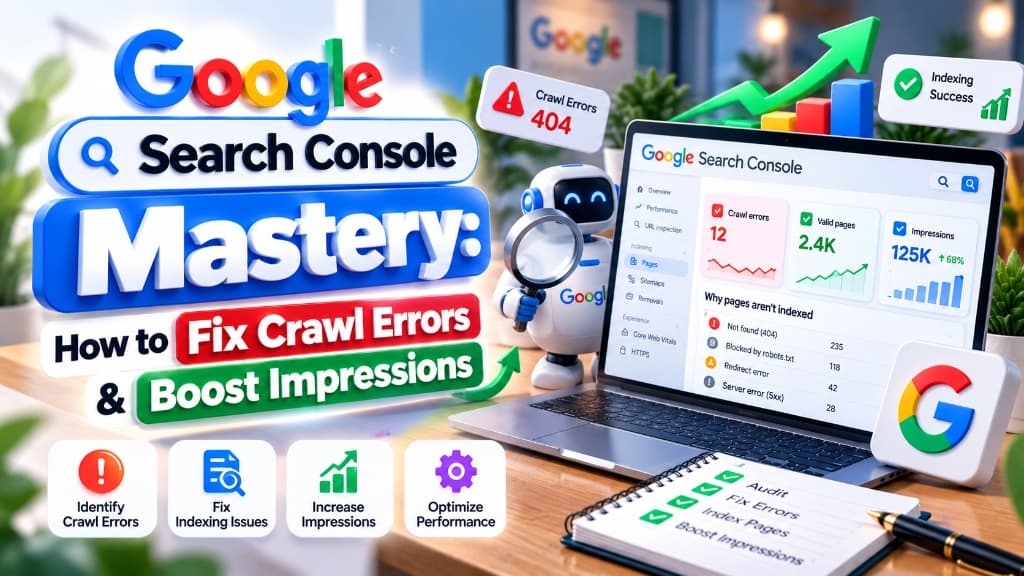
A practical, diagnostic guide to Google Search Console mastery. Learn how to isolate server errors, resolve soft 404s, unclog crawl bottlenecks, and scale your search impressions.
A complete 50-point technical SEO checklist for 2026. Audit crawlability, Core Web Vitals, mobile usability, schemas, and AI search readiness for top rankings.
Local SEO Bangladesh is the fastest way for local businesses to capture high-intent customers actively searching for your services in Dhaka, Chittagong, and across Bangladesh. This complete 2026 guide covers Google Maps optimization, Local Pack ranking, and Google Business Profile tactics.
Join Our Newsletter for Weekly SEO Trends and Algorithm Updates



 Technical SEO