Key Takeaway
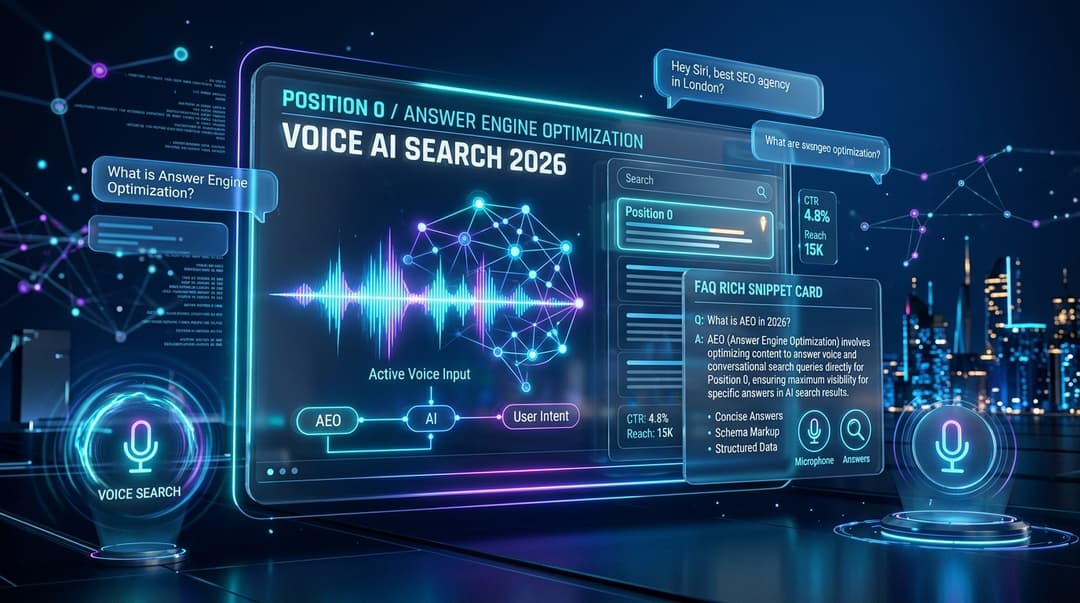
The definitive 2026 playbook on AI Search Optimization. Learn how Retrieval-Augmented Generation (RAG), entity knowledge graphs, and Information Gain scores determine brand citations across Perplexity AI, ChatGPT Search, Claude, and Google Gemini.
The New Reality of Search: How AI Answers are Replacing Traditional Clicks
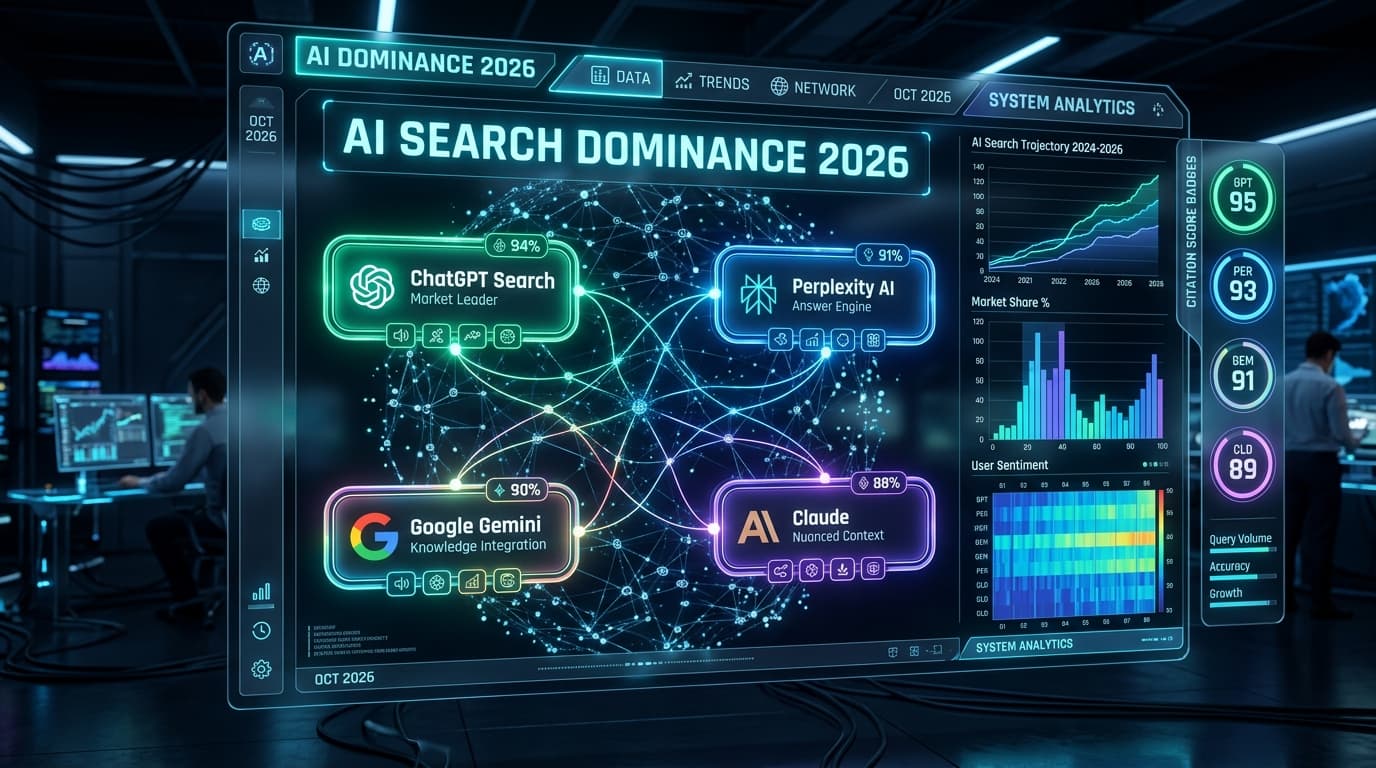
Search engines are no longer passive directories of URLs. With OpenAI ChatGPT Search, Perplexity AI, Google Gemini (AI Overviews), and Anthropic Claude capturing millions of commercial queries daily, search has transformed from keyword retrieval to conversational synthesis.
When potential buyers ask an AI engine "Who is the best technical SEO specialist for e-commerce brands?" or "How do I fix Core Web Vitals INP delays?", the AI doesn't give them 10 links to browse. It reads, evaluates, and directly quotes 2 to 4 authoritative primary sources while generating its response.
🎯 The Core Goal of AI Search Optimization:
Your website must become the unambiguous, verified factual consensus that Large Language Models (LLMs) ingest and recommend when answering questions in your niche.
How Large Language Models (LLMs) & RAG Systems Select Sources
To win visibility inside AI search engines, you must understand the underlying mechanics of Retrieval-Augmented Generation (RAG). AI models use a multi-stage pipeline to select citation sources:
- 1. Vector Embedding Similarity: The search query is converted into a high-dimensional mathematical vector. The AI retrieves content chunks with the highest semantic cosine similarity from its vector database.
- 2. Information Gain Scoring: Google and OpenAI algorithms measure whether a passage introduces novel, unique insights or simply repeats existing knowledge. Pages with original benchmarks, proprietary data, and case studies receive top priority.
- 3. Entity Graph Verification: The model cross-references your brand, founder, and claims against verified knowledge repositories (Wikidata, Google Knowledge Graph, Schema.org, industry press) to confirm authority.
- 4. Passage Extractability: LLMs favor clean, self-contained paragraphs (40–70 words) that directly answer the query without fluff or circular reasoning.
The 6 Pillars of Winning AI Search & Generative Engine Citations
Pillar 1: Direct Declarative Answer Architecture
Structure every primary section of your content using the Inverted Pyramid Answer Model. Place a definitive 2-to-3 sentence summary immediately beneath each heading before diving into detailed explanations. Learn more about answer capsules in our AEO Blueprint Guide.
Pillar 2: Nested Schema.org JSON-LD Knowledge Graphs
Structured data is the universal language of AI search bots. By embedding rich JSON-LD Schema Markup—including TechArticle, FAQPage, ProfessionalService, and Person with sameAs social citations—you provide unambiguous entity connections that LLMs index instantly.
Pillar 3: First-Party Research & Verifiable Case Studies
LLMs are trained to avoid hallucinations by citing verifiable data. Publishing real client benchmarks, traffic growth proof (such as our verified 1.18M Organic Clicks Case Study), and empirical experiments makes your website an indispensable reference point.
Pillar 4: Semantic Silos & Topical Monopoly
AI search engines evaluate domain-wide topical completeness. To be recognized as an authority, your website must cover every subtopic, edge case, and related question surrounding your core service through structured topic clusters and internal contextual links.
Pillar 5: Multi-Format Data Presentation (Tables & Workflows)
AI parsers process structured HTML tables and numbered sequences with significantly higher extraction accuracy than unformatted text blocks. Summarizing complex processes into clean tables dramatically increases your citation probability.
Pillar 6: High-Authority Digital PR & Unlinked Entity Mentions
Off-page mentions across trusted industry media, podcasts, and digital publications reinforce your brand entity in the AI's training data. Pair this with our comprehensive GEO Services to solidify your presence across generative platforms.
Traditional Google SEO vs. AI Search Optimization
| Comparison Vector |
Traditional Google SEO |
AI Search & GEO (2026) |
| Primary Output |
10 Organic Blue Links & SERP Snippets |
Direct AI Answers, Perplexity & ChatGPT Sources |
| Ranking Algorithm |
PageRank, Anchor Text, On-Page Keywords |
RAG Vector Embeddings, Information Gain, E-E-A-T |
| Content Format |
Long-form keyword-optimized articles |
Modular Answer Capsules, Tables & Verified Data |
| Technical Focus |
Crawl budget, speed, canonical tags |
JSON-LD Knowledge Graphs, Clean DOM, LLM Crawlability |
Step-by-Step Action Plan to Make Your Site AI-Ready Today
- Audit Your Entity Footprint: Search for your brand and services across ChatGPT, Perplexity, and Gemini to see how AI currently perceives and cites your business.
- Implement Nested Knowledge Graphs: Use our free Schema Markup Generator to build rich JSON-LD data for your organization and authors.
- Upgrade High-Traffic Content with Answer Boxes: Rewrite top-ranking pages to include direct question-and-answer definitions that AI bots can easily extract.
- Test Technical Header Directives: Verify that server response codes and bot access permissions are healthy with our HTTP Header & SSL Checker.
- Check Core Site Diagnostics: Run a full diagnostic check using our Free Deep SEO Audit Tool.
Ready to Dominate AI Search & Google in 2026?
Partner with Abdullah to engineer an enterprise-grade AI Search, Generative Engine Optimization (GEO), and technical SEO roadmap tailored to your industry.

Abdullah Saleh
Lead SEO Strategist & AI Search Architect
Abdullah Saleh is an Organic Business Growth Specialist and Technical SEO Expert helping global brands achieve #1 Google rankings and authoritative citations across Generative AI search engines.

 Keyword Strategy