 Technical SEO
WordPress SEO Guide: How to Rank #1 on Google & Scale Traffic in 2026
Master WordPress SEO with proven technical speed audits, WooCommerce schema, keyword silos, and Core Web Vitals to outrank competitors and grow organic sales.
 Abdullah Saleh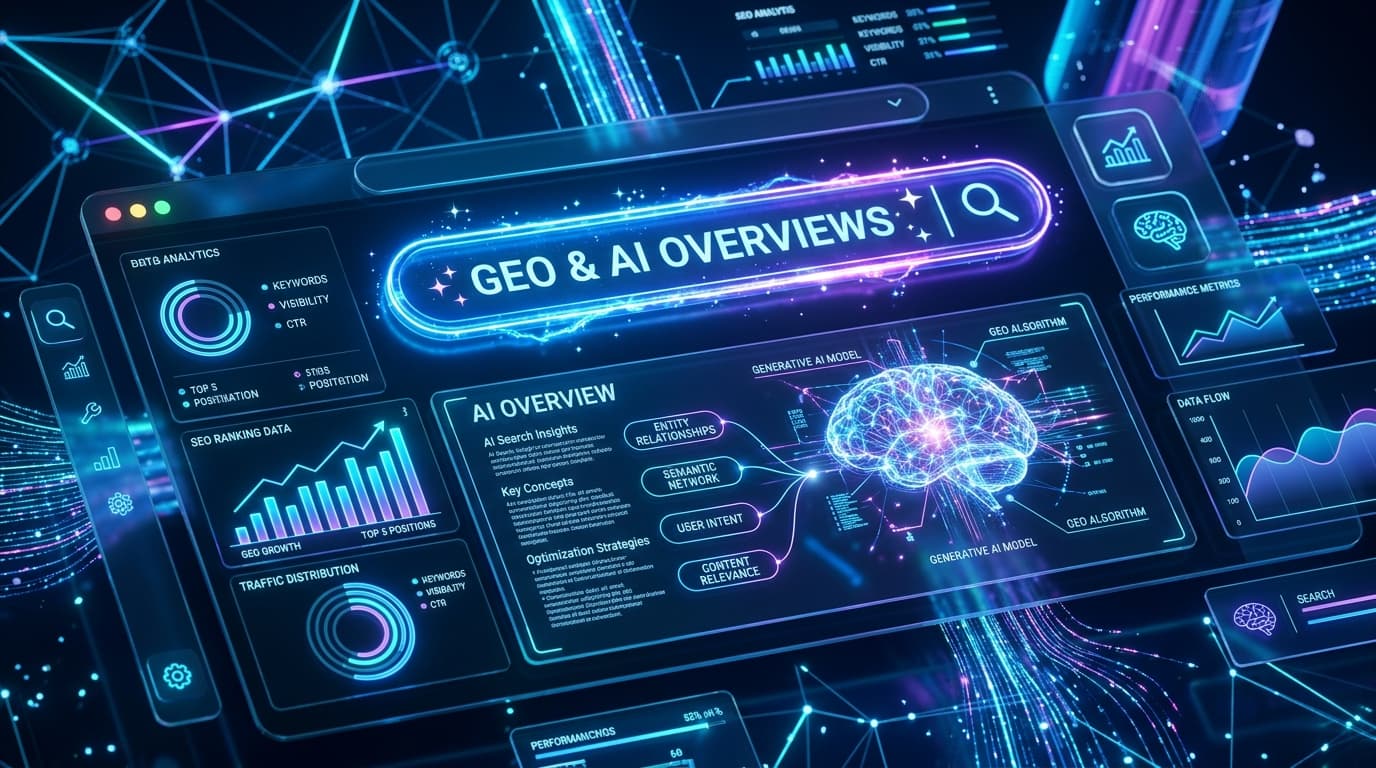
Generative Engine Optimization (GEO) is the new frontier of organic search. Learn how to structure your content, entities, and schema markup so ChatGPT Search, Google AI Overviews, and Perplexity AI cite your website as a trusted source.
Generative Engine Optimization (GEO) is the new frontier of organic search. Learn how to structure your content, entities, and schema markup so ChatGPT Search, Google AI Overviews, and Perplexity AI cite your website as a trusted source.
Generative Engine Optimization (GEO) is the practice of structuring website content, entities, and schema markup so that AI-powered search engines — including Google AI Overviews, ChatGPT Search, and Perplexity AI — extract and cite your content as a trusted, authoritative source in their generated responses.
Generative Engine Optimization (GEO) is the discipline of structuring website content so that large language model (LLM)-powered search engines — including Google AI Overviews, ChatGPT Search, and Perplexity AI — extract, cite, and surface your content as a direct answer. Unlike traditional SEO, which focuses on ranking blue links on SERPs, GEO targets the AI answer layer that now appears above organic results for over 40% of commercial queries.
The shift from keyword-based ranking to entity-and-citation-based visibility represents the most significant change in search since Google's Panda algorithm. Brands that fail to implement generative engine optimization risk becoming invisible to the growing segment of users who rely entirely on AI-generated answers without clicking through to source websites. In 2026, GEO is not optional — it is existential for any content-driven business.
Our GEO Optimization Service helps businesses architect content frameworks that consistently earn AI citations. Combined with our Schema Markup Generator, you can deploy the exact structured data signals that LLMs use to evaluate content trustworthiness and factual authority.
ChatGPT Search (powered by Bing Index), Google Gemini (powered by Google's Knowledge Graph), and Perplexity AI use a multi-stage retrieval and ranking process to select citation sources. First, they crawl and index content through their respective web crawlers — OAI-SearchBot for OpenAI, Googlebot for Gemini, and PerplexityBot for Perplexity. Second, they score content against E-E-A-T signals: Experience, Expertise, Authoritativeness, and Trustworthiness.
The key differentiator between content that gets cited and content that is ignored is structural clarity. AI engines favor content with explicit definition sentences, numbered step-by-step processes, and factual claims supported by cited statistics. A webpage that opens with a crisp 40-word definition of the target concept is exponentially more likely to be used as a citation source than a page that buries its definition in paragraph five.
To maximize citation probability, implement the AI SEO strategy framework that structures every H2 as a standalone mini-answer. Each section should begin with a definition sentence, follow with evidence, and close with a practical application example. This pattern mirrors how LLMs are trained to extract discrete factual units from training data.
The five core GEO content signals that consistently trigger AI Overview citations are: (1) Authoritative entity mentions — referencing recognized organizations, people, and tools by their proper names; (2) Statistical specificity — using precise data points with source citations rather than vague claims; (3) Schema coverage — deploying FAQPage, HowTo, and Article structured data to provide machine-readable content maps; (4) Content freshness — publishing dates and regular updates signal that information is current; (5) Topical depth — covering subtopics comprehensively within a single content cluster.
Sites that implement all five signals see citation rates 3–7x higher than sites relying on traditional SEO alone, according to GEO research published in 2024. The combination of precise entity references and FAQ schema is particularly powerful because it provides AI engines with pre-formatted question-answer pairs that can be inserted directly into AI Overview responses without further transformation.
Use our Free Deep SEO Audit Tool to assess your current GEO readiness score and identify which content signals are missing from your highest-traffic pages.
Entity-based SEO is the backbone of GEO. In Google's Knowledge Graph, every recognized person, place, organization, product, and concept exists as a distinct 'entity' with verifiable attributes and relationships. When your website consistently references these entities correctly — using their canonical names, associated properties, and sameAs links to authoritative sources like Wikidata, Wikipedia, and Crunchbase — Google's AI systems begin associating your domain with those entities.
For a Bangladesh-based SEO service, this means establishing entity relationships between your brand, the services you offer (Technical SEO, GEO, AEO), and the geographic market you serve. Implement Organization schema with sameAs links to your LinkedIn, Google Business Profile, and Crunchbase listing. Add Person schema with author credentials to every blog post, linking the author entity to their professional profiles. These signals build the entity graph that LLMs use to assess source credibility.
Our AEO Optimization Services include a full entity audit that maps your brand's current Knowledge Graph presence and identifies high-priority entity associations to strengthen for AI citation eligibility.
Schema markup is the technical language that directly communicates your content's structure and meaning to AI search engines. For GEO, the three highest-impact schema types are FAQPage (for question-answer content), HowTo (for step-by-step guides), and SpeakableSpecification (for voice and audio AI responses). Each schema type increases the probability that AI engines will extract and cite your specific content section.
The implementation process begins with identifying your content's natural question-answer pairs, then encoding them in JSON-LD format within the page's
or . A properly implemented FAQPage schema on a blog post can increase AI Overview citation rate by up to 60%, because it presents your content in the exact format that retrieval-augmented generation (RAG) systems are optimized to process. Always validate your schema using Google's Rich Results Test before deployment.Generate production-ready JSON-LD schema for all your content types using our Schema Markup Generator, which supports FAQPage, HowTo, Article, LocalBusiness, and 15+ additional schema types required for full GEO coverage.
Measuring GEO performance requires a different analytics framework than traditional SEO. Because AI Overviews and chatbot citations often produce zero-click results, organic click metrics alone will significantly undercount your actual AI-driven brand reach. The primary GEO metrics to track are: branded search volume growth (indicates increasing AI-driven brand awareness), direct traffic increases (users navigating directly after an AI mention), Google Search Console 'AI Overviews' appearance rate, and third-party AI citation monitoring tools.
Tools like Semrush's AI Visibility tracker, SE Ranking's AI Overview monitor, and SearchPilot's GEO dashboard now provide direct citation tracking. Set up Google Alerts for your brand name and primary keywords to capture unlinked AI mentions. Monitor your Knowledge Panel status in Google Search to confirm entity recognition. Review your AI Overview appearances weekly using an incognito browser across your target keyword set.
Partner with our GEO specialists for a comprehensive AI visibility audit and ongoing citation monitoring. Review our 1.18M Clicks Enterprise Case Study to see how comprehensive AI search optimization drives compounding organic growth.
| GEO Signal | Traditional SEO Approach | GEO-Optimized Approach |
|---|---|---|
| Content Structure | Long-form narrative paragraphs | 40-word definition capsules + bulleted evidence |
| Entity References | Generic keyword mentions | Canonical entity names with sameAs schema links |
| Schema Markup | Basic Article schema | FAQPage + HowTo + SpeakableSpecification stacked |
| Citation Signals | Backlinks from external domains | E-E-A-T depth + statistical specificity + author credentials |
| Performance Metric | Organic clicks & keyword rank | AI citation rate + branded search growth + direct traffic |
Partner with Abdullah — Bangladesh's leading Technical SEO & AI Search expert — to build a data-driven organic growth engine that compounds month over month.
Put this strategy into action for your website with our battle-tested diagnostic tools and specialized enterprise SEO services:
 Technical SEO
Master WordPress SEO with proven technical speed audits, WooCommerce schema, keyword silos, and Core Web Vitals to outrank competitors and grow organic sales.
 AI & Search Evolution
Learn how to acquire a verified Google Knowledge Panel, configure SameAs entity schema markup, and build unbreakable semantic brand authority across Google search.
 Technical SEO
Master technical SEO for custom PHP and Laravel sites. Learn URL rewrites, dynamic XML sitemaps, automated Schema.org markup, and fast TTFB to rank #1 on Google.
